


Phalaenopsis
xPhalaenopsis (ˌfa-lə-ˈnäp-səs ) are in the orchid family and despite being one of thousands of different types of orchids, these have become so ubiquitous across America that they are essentially synonymous with "orchid" in most people’s mind.
| Phalaenopsis Care | |
|---|---|
| Difficulty | Easy |
| Light | Low to medium, never direct sun |
| Temperature | Keep above 60 degrees |
| Water | Weekly bark soak (possibly more in drier areas) – keep water out of the leaf axils |
| Fertilizer | Urea-free when growing a leaf |
In fact, there are only 80 different Phalaenopsis species in the wild, found from India to Southeast Asia. That’s a drop in the bucket compared to all 30,000+ orchid species. Yet, despite the limited number of Phalaenopsis types in the wild, people have created hundreds of thousands of beautiful Phalaenopsis hybrids. We hand pick each one of our Phalaenopsis from a highly awarded breeder ensuring health, form and unique beauty with each one.
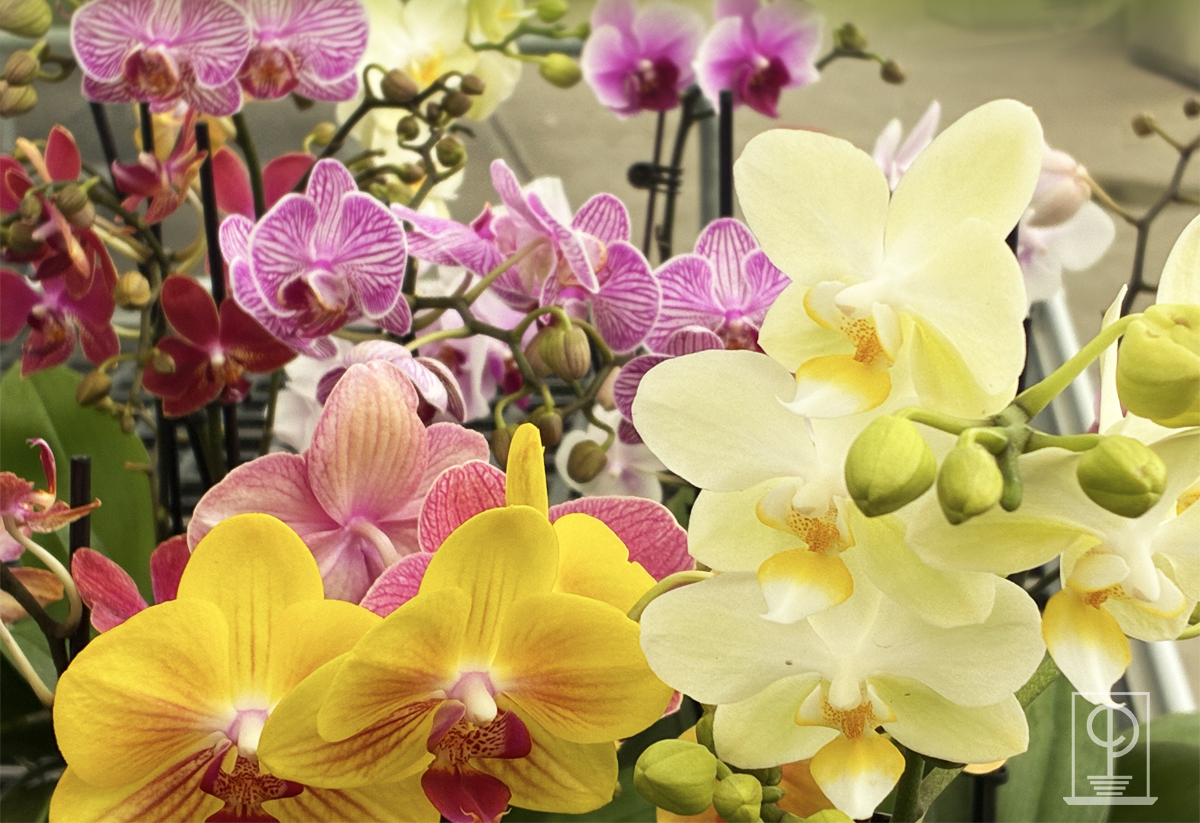 The mere 80 species of Phalaenopsis have been hybridized to have just about every color and pattern
The Planted Parlour’s Tips and Tricks for Success!
- Skip the ice cubesPhalaenopsis come from the hot tropical forests of Southeast Asia, not Antarctica. Phals potted properly need a full drenching of water, once a week, or more in low-humidity areas.
- Repot every year or twoOrchids live in trees in the tropical jungle, getting water via their roots that dangle in the warm, humid air. Potting orchids in bark mimics that humid forest as the roots can live off the moist bark as it slowly dries out between waterings. That bark tends to turn into dirt in a year or two and the roots don’t like that, so freshen up the bark – usually no need for a different pot.
Learn More…
Like most of the orchids we grow as houseplants, Phalaenopsis are "epiphytic", meaning that in their natural habitat they grow on trees, and not in the ground. That is why it is best to grow them in orchid bark. The roots are not suffocated as they would be with dirt (or soggy moss) and a weekly watering that saturates the bark will provide days of humidity that the roots can enjoy, as that mimics their humid jungle native habitat.
The normal cycle for a Phalaenopsis is to grow a leaf over the course of several months and then bloom for months. In years past that was usually a yearly cycle but breeders have worked to develop Phalaenopsis that bloom multiple times a year. And considering a bloom spike can last 3-5 months they can be in bloom almost year round when happy and healthy. As with all plants, only fertilize when they are growing, and as with all orchids these need urea-free fertilizer.
Reblooming a Phalaenopsis is easy if you’ve potted it in bark and give it moderate to low light and normal home temperatures. If you’re struggling with blooming your Phalaenopsis, consider:
- Giving it slightly more light (never direct sun!)
- Giving it a cool dip, move it closer to a window that might get into the low 60s or even upper 50s at night. This, of course, can only be done in winter, but some species of Phalaenopsis are triggered to bloom with cooler temperatures – and those species can influence their hybrids in that way.
- If it is poorly potted this will definitely prevent the plant from blooming. Phalaenopsis potted in moss decline over the course of about a year (most people think they killed it, but the way it was potted killed it). Careful watering can extend their life in moss but they definitely prefer an orchid bark mix – and the happier they can get the more likely they are to bloom.
And what about bloom fertilizer? It won’t trigger your plant to bloom! Bloom fertilizer is intended to help/enhance the flower of a plant that is already going to bloom by adding extra phosphorus. We don’t use bloom fertilizer on our collection.
In general, you should make your plant happy year round and it will reward you with beautiful flowers. And when it does bloom (or “send up a bloom spike”, as they say in the orchid world) and starts to produce buds, be sure to keep the plant’s position the same, never turning it in a different direction from the light source as that will produce the most natural looking, elegant blooms.
As we said above, orchid species (the original types that are found in the wild) are limited to only 80 types. Most of them are also very small, but they’re still incorporated into breeding programs for their color or their shape. Below is a gallery of Phalaenopsis species from our collection.