Palms are the classic houseplant. One of the three most popular houseplants during the Victorian houseplant craze, iconized in the Art Deco era, returning to popularity in the 1960s and 70s and evolutionarily one of the oldest types of flowering plants on earth, emerging around 140 million years ago.
In today’s big box store world, palms are not heavily promoted. This is because, unlike most plants that can be propagated by the hundreds via cuttings, or thousands via tissue culture, palms can only be grown from seed, making them much harder to produce on a mass level and somewhat more expensive than other types of plants. The only palms that the big box nurseries typically sell are fast-growing ones like Majesty Palms or Mexican Fan Palms, which are great for outdoors but don’t make good indoor plants.
Despite their slow growth, many tropical palms make excellent houseplants. They can survive neglect, take a wide variety of light conditions (but never direct sun) and provide elegance to any decor.
Varieties and Care
Parlor Palm
The classic "starter palm," Chamaedorea elegans, or Parlor Palm, is small, compact, and easy to grow. It’s been a popular houseplant since Victorian times because it tolerates the dim light and fluctuations found in a typical home of the time.
| Chamaedorea elegans Care |
|---|
| Difficulty | Easy |
| Light | Low to medium, indirect light |
| Temperature | 65°F – 80°F |
| Water | Allow top inch of soil to dry; sensitive to overwatering |
Kentia Palm

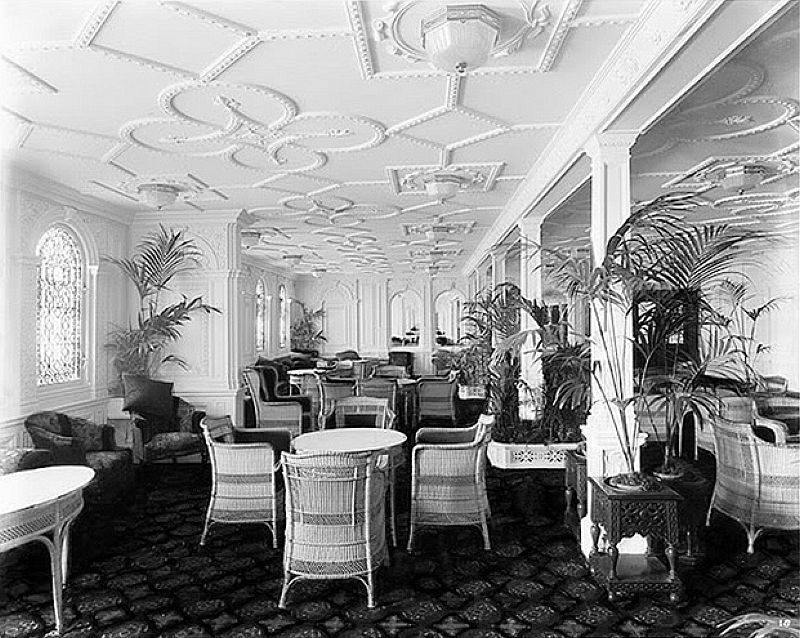
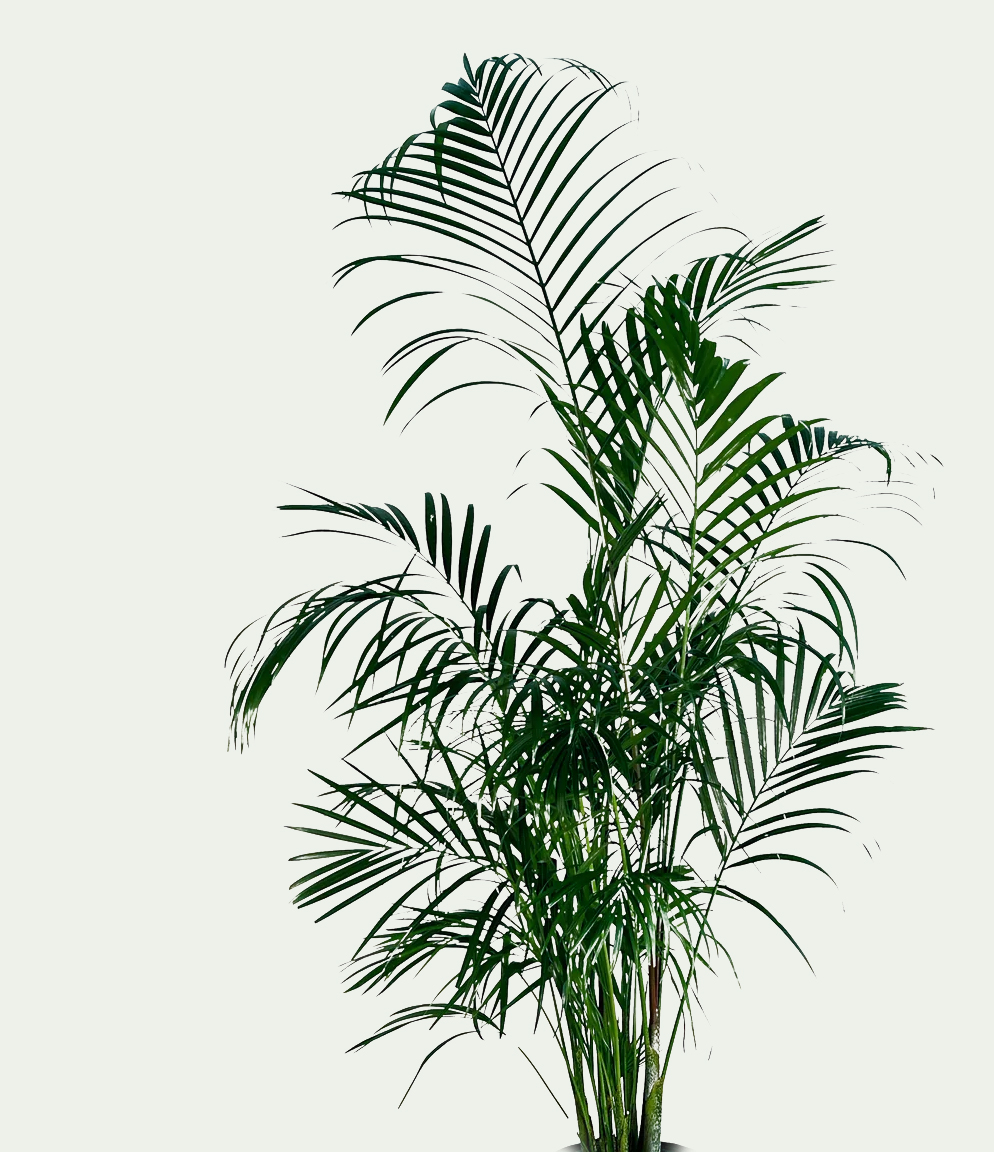
Howea forsteriana, or Kentia Palm, is incredibly elegant houseplant with dark green, arching fronds. It is one of the most durable palms in existence, capable of surviving in low light and handling the dry air of homes further inland, but it loves it here at the coast with our humidity and moderate temperatures. This plant has enormous historic value being one of the most popular plants in the Victorian Era. You can see it in Hollywood classics of the 50s and 60s, the Titanic’s dining room was decorated with Kentias (see photo above/right) and Queen Victoria was such a fan that she left instructions that Kentias be placed around her coffin.
The scientific name of the genus, Howea, comes from the fact that it is native only to Lord Howe Island, which is between Australia and New Zealand. All palms are slightly more expensive as they can be grown only from seed, but Kentias are hindered even more by the strict restriction of their seed distribution as it is considered vulnerable by the World Conservation Union. That restriction on production unfortunately makes them more expensive than other palms.
| Howea forsteriana Care |
|---|
| Difficulty | Easy |
| Light | Low to bright, indirect light (very versatile) – can take more sun here at the coast. Cannot take hot sun. |
| Temperature | 35°F – 80°F – hardy outside here at the coast, very happy inside. |
| Water | Allow top 25% of soil to dry before watering |
Areca Palm
Also known as the “Butterfly Palm,” Dypsis lutescens, or Areca Palm, is a clumping palm with fine-textured, yellow-green fronds. It’s a fast grower and a great “floor plant” for filling corners. When it gains some height, it’s yellow stems brighten up a darker corner.
| Dypsis lutescens Care |
|---|
| Difficulty | Moderate |
| Light | Bright, indirect light (avoid direct hot sun) |
| Temperature | 65°F – 75°F |
| Water | Keep moist; sensitive to fluoride and salts in tap water. |
Bamboo Palm
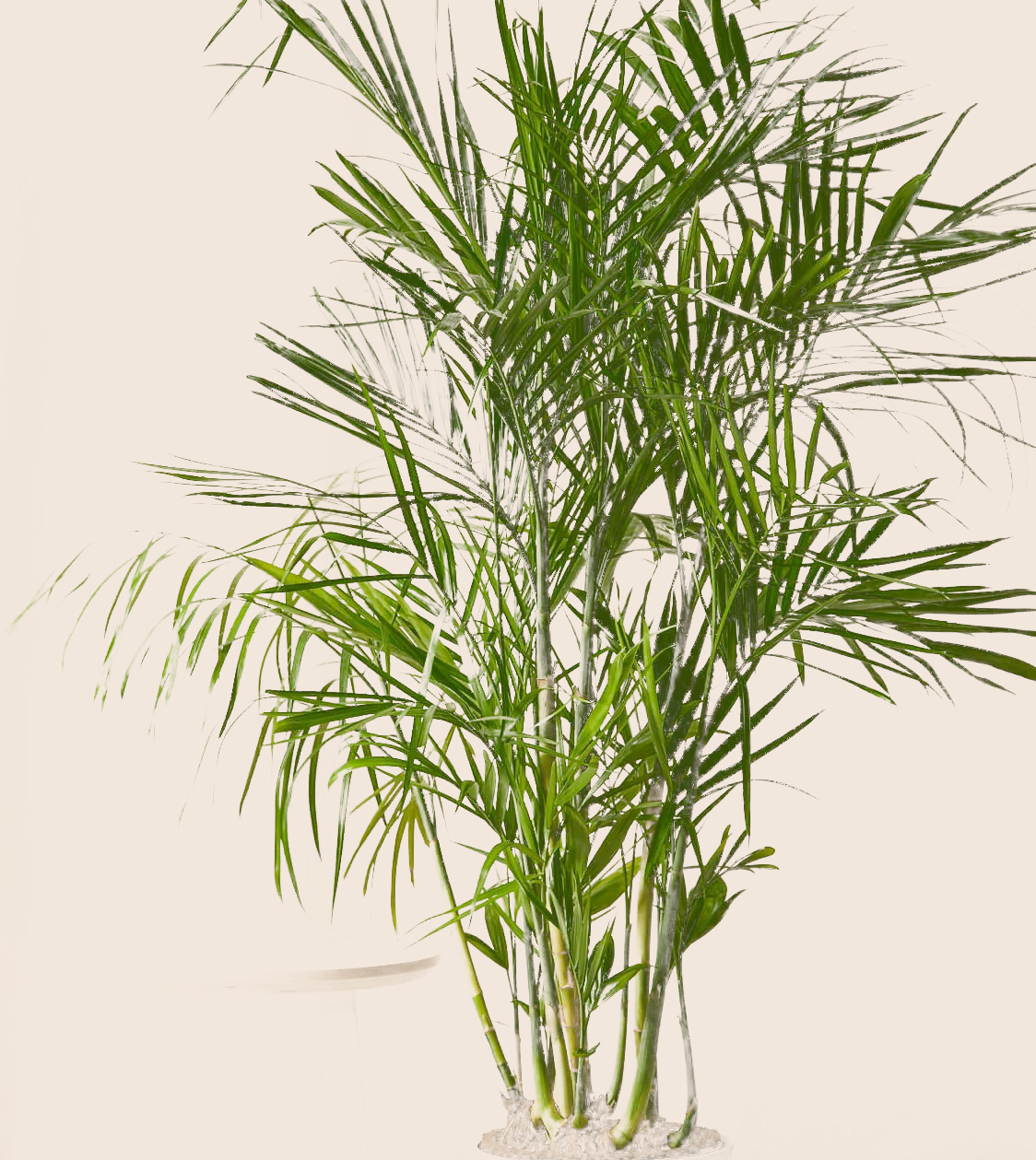
Chamaedorea seifrizii, aka Bamboo Palm, palm gets its name from its multi-stemmed growth that resembles bamboo canes. It is a fantastic air purifier and grows vertically rather than wide, making it perfect for narrow spaces in apartments or offices.
| Chamaedorea seifrizii Care |
|---|
| Difficulty | Easy |
| Light | Low to medium, indirect light |
| Temperature | 65°F – 80°F |
| Water | Prefers consistent moisture; do not let it dry out completely |
Lady Palm
Rhapis excelsa, commonly known as the Lady Palm, is a beautiful fan palm with thick, dark green fronds that look like fingers. It is extremely slow-growing and very sturdy. Because its leaves are thicker, it is much less prone to the “crispy tips” that plague thinner-leaved palms. As it grows, its furry brown trunk gains more prominence, making it an interesting display plant.
| Rhapis excelsa Care |
|---|
| Difficulty | Easy |
| Light | Low to bright, indirect light (thrives in shade) |
| Temperature | 60°F – 80°F |
| Water | Water when the top inch of soil feels dry |
Fishtail Palm
The Fishtail Palm (Caryota mitis) has leaflets that are jagged and torn at the edges, looking like the tail of a fish. It is a “clumping” palm, meaning it grows multiple stems from the base, creating a very full, lush look. It grows excellently here at the coast as it prefers higher humidity, which we naturally have.
| Caryota mitis Care |
|---|
| Difficulty | Moderate |
Moderate
| Light | Bright, indirect light (this is not a low light palm) |
| Temperature | 65°F – 85°F (Very sensitive to cold drafts below 60°F) |
| Water | Keep soil fairly moist, but never soggy. |
The Planted Parlour’s Tips and Tricks for Success!
- Pure water is bestFor your palms to be looking their best, use rainwater, reverse-osmosis or distilled water. Brown leaf tips can develop on many palms from salts and chemicals in tap water. Fishtail are particularly susceptible to water issues.
- Palm fertilizer IS differentWhile fertilizing should always be done sparingly for houseplants unless they’re growing, it’s important to know that palms can benefit from palm fertilizer as they have unique potassium and magnesium needs. While typical houseplant fertilizer will be ok, palm fertilizer will result in better growth.
- Repot reluctantlyPalms aren’t big fans of having their roots touched, but there are times that they outgrow their pot. Be as delicate as possible with the roots when moving the plant from one pot to another. If the roots have grown through the bottom of the pot it is advised that you destroy the pot rather than disturb the palm (that’s why you should keep it potted in an inexpensive plastic pot set inside a decorative pot). If it was properly planted before the mix may fall away somewhat, which is ok, but quickly get it into its new pot with fresh, well draining mix. It’s best to do this when you can give the palm ideal conditions after repotting, as the plant will sulk after repotting and won’t do well if the environment is poor. If your palm is outside, don’t repot when temperatures are going to dip below 60 degrees F at night.
- Prune lightlyThe queen palms we see in malls and along boulevards are notoriously over-pruned. Unlike houseplant palms, pruning forty foot tall trees costs a lot of money, so people tend to opt towards over-pruning, so they have to prune less often. But repeated over-pruning actually weakens those palms. Houseplant palms also prefer less pruning. Ideally only remove leaves that are totally brown, cutting them off where they meet the trunk. The plant is still using the yellow leaves for energy. If pruning to reduce size on a mature palm, never remove more than 25% of the foliage. Less is more. And never top cut a palm, as this will kill the plant.
Learn More…
In the 1960s archaeologists found a clay jar containing ancient date seeds that carbon dating determined were over 2,000 years old. They were kept on display but thought to be inviable for 40 years until, in 2005, a scientist decided to see if the seeds could germinate with some stimulating hormones…and it turned out they could. That tree grew into a mature date tree which they named Methuselah. Since then, other ancient date seeds have been germinated and named such as Hannah, Judith, and Rebecca.
A Truly Rare Plant
Palms are ancient plants. The event that wiped out the dinosaurs 66 million years ago also killed a lot of plants. Palms not only survived the event, there is much evidence that they thrived from the event, taking advantage of the open spaces left from dead trees and underbrush. Despite their vigor back then, there is one species of palm that is on its last leg today. While not as old of a species as to have gone through the dinosaur extinction, Hyophorbe amaricaulis currently has only one tree left. It lives in the Botanic Gardens of Curepipe on the island nation of Mauritius. Hyophorbe amaricaulis is self-sterile, meaning it cannot pollenate itself, it needs another tree of its species to do so. As that tree is the only one of its kind left, it cannot be pollenated, and therefore there are no seeds. This tree is considered one of the rarest living things on earth. As noted above, palms cannot be tissue cultured or divided (except for clumping ones), they can only reproduce via seed, so scientists are scrambling to figure out how to get this lonely palm to produce seed.
Some Palm Statistics
- Tallest Palm: Ceroxylon quindiuense (Quindío Wax Palm), which can grow to 200 feet tall, the height of a 15 story building.
- Biggest Seed: Lodoicea maldivica (Coco de Mer) has a nut that can weigh up to 66 pounds.
- Longest Palm Frond: Raphia regalis (Raffia Palm), from Central Africa, it towers above the surrounding jungle and has fronds that can reach up to 82 feet long – it is the longest leaf in the world. One tree produced a frond reaching the world record of 85 feet.

This plant is
PET FRIENDLY!